Wednesday, February 25, 2009

Phishing: Examples and its prevention method

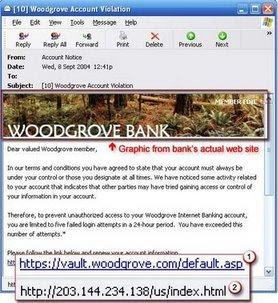
Phishing is a process of illegally acquiring personal and sensitive information from people such as credit card information, usernames and passwords. They may seem like web sites from a trustworthy entity but in fact, as soon as the victim inputs his or her information the phishing site will record all of the information and will exploit those information to fraud on the victim.

An example of a phishing site.


Ways to prevent phishing scams: Incorrect company name. Often the web address of a phishing site looks correct, but actually contains a common misspelling of the company name or a character or symbol before or after the company name. Look out for tricks such as substituting the number "1" for the letter "l" in a web address (for example, www.paypa1.com instead of www.paypal.com).
  • Missing slash. To verify that you're on a legitimate Yahoo! site, make sure a forward slash (" / ") appears after "yahoo.com" in the Address bar
  • If you not sure if a site is authentic, don't use your real password to sign in. If you enter a fake password and appear to be signed in, you're likely on a phishing site. Do not enter any more information; close your browser. Keep in mind, though, that some phishing sites automatically display an error message regardless of the password you enter. So, just because your fake password is rejected, don't assume the site is legitimate.

  • Use a web browser with anti-phishing detection. eg, Internet explorer and Mozilla firefox

Tuesday, February 24, 2009

How E-commerce can reduce cycle time, improve employees's empowerment and facilitate customer support

With the increasing usage of internet and the advancement of technology, more and more people are starting to see the convenience of e-commerce. With e-commerce, people can make purchases without even stepping out of their house. What differentiate e-commerce apart from the conventional way of selling and buying is reduced cycle time and the convenience.

Cycle time is the time where a process needed to complete from beginning until the end of it. This system can help to reduce the cycle time by creating a fast and direct system without wasting any valuable time. For example, customers can get immediate responses from the dealers or the supplier once the customers request to purchase the items on the system. From the system, it will immediately get to the suppliers without wasting time and money to go to the shop and they can make the payment online through credit cards. After the company receives the orders and payment, they will prepares the items accordingly and send it to the customers. Thus, the e-commerce can reduce the cycle time of this process.

Besides reduced cycle time, e-commerce allows employees to make decisions. Empowerment by management to employees (especially customer service) can react quickly to solve customers demands or problems. They also
need to check on the system and process any transactions that requested by the customers. With empowerment, customer satisfaction will be increased due to the swift respond from the company personnel and thus increasing the usage of e-commerce.

Other than that, e-commerce is basically done on web sites. The advantage of the web site is that it can serve several purposes to facilitate the buying process. An added advantage to e-commerce is that customers can also seek help and advice from customer support. Any doubts and uncertainty can be cleared and verified via the customer support.

Sunday, February 22, 2009

Electronic currency


What Does Electronic Currency Trading Mean?It is a method of trading currencies through an online brokerage account. Electronic currency trading involves converting base currency to a foreign currency at the market exchange rates through an online brokerage account. And Electronic currency traders use analysis based on technical and fundamental indicators to help them forecast the movement of the currency pair being traded. Because currency trading by this method is wholly electronic, execution speeds are extremely fast, allowing the trader to quickly buy and sell currencies to cut losses and take profits at a moment's notice.

Technically electronic or digital money is a representation, or a system of debits and credits, used (but not limited to this) to exchange value, within another system, or itself as a stand alone system, online or offline. Also sometimes the term electronic money is used to refer to the provider itself. A private currency may use gold to provide extra security, such as digital gold currency. An e-currency system may be fully backed by gold (like e-gold and c-gold), non-gold backed, or both gold and non-gold backed (like e-Bullion and Liberty Reserve). Also, some private organizations, such as the US military use private currencies such as Eagle Cash.
Many systems will sell their electronic currency directly to the end user, such as Paypal and WebMoney, but other systems, such as e-gold, sell only through third party digital currency exchangers.

In the use of off-line electronic money, the merchant does not need to interact with the bank before accepting a coin from the user. Instead he can collect multiple coins Spent by users and Deposit them later with the bank. In principle this could be done off-line, i.e. the merchant could go to the bank with his storage media to exchange e-cash for cash. Nevertheless the merchant is guaranteed that the user's e-coin will either be accepted by the bank, or the bank will be able to identify and punish the cheating user. In this way a user is prevented from spending the same coin twice (double-spending). Off-line e-cash schemes also need to protect against cheating merchants, i.e. merchants that want to deposit a coin twice (and then blame the user).

The main focuses of digital cash development are 1) being able to use it through a wider range of hardware such as secured credit cards; and 2) linked bank accounts that would generally be used over an internet means, for exchange with a secure micropayment system such as in large corporations (PayPal).

Theoretical developments in the area of decentralized money are underway that may rival traditional, centralized money. Systems of accounting such as Altruistic Economics are emerging that are entirely electronic, and can be more efficient and more realistic because they do not assume a zero-sum transaction model.

Corporate blogging

Blogs - an abbreviation of 'weblogs' - are published on the web, typically as microsites standing by themselves but today also as parts of traditional web sites. They reflect the interests, thoughts and opinions of the person, sometimes persons, publishing the blog. Blogs are characterized by frequent updates, an informal tone and many links to other blogs and web sites.A corporate blog is a blog published by or with the support of an organization to reach that organization's goals. In external communications the potential benefits include strengthened relationships with important target groups and the positioning of the publishing organization (or individuals within it) as industry experts. Internally blogs are generally referred to as tools for collaboration and knowledge management.


Blogging has caused quite a buzz. From political activists to aspiring novelists, industry pros and avid hobbyists, everyone seems to be starting a blog. Recent articles in Business Week and Forbes demonstrate how even the mainstream media is taking notice of their unprecedented growth and increasing effect on our society. But can corporate blogging really deliver measurable return-on-investment for your business?
In this paper, we address the following questions: why would a company want to start blogging? Who should blog? What makes a blog successful? And how can companies use this type of website to facilitate positive business growth?
To find the answers to these questions, we surveyed bloggers at hundreds of companies and conducted in-depth interviews with representatives from six corporations currently leading the way in blogging activities. What we discovered was that for the majority of our survey sample —including some of today’s largest corporations and scrappiest underdogs —corporate blogs are, in fact, living up to all the hype.


Corporate blogs are giving established companies and obscure brands alike the ability to connect with their audiences on a more personal level, build trust, collect valuable feedback and foster strengthened business relationships. More importantly, these companies are enjoying tangible returns in their blogging investment in the form of increased sales, partnerships, business opportunities, press coverage and lead generation.


Companies that employ a well thought out blogging strategy encourage the strongest community goodwill, and that goodwill, in turn, promotes significant marketing and sales gains. It is said that success breeds success.


This holds very true for successful blogs. There is chain reaction that begins with a real desire on the part of the blogger to provide value and connect with their audience. The blogger shares useful and engaging content —the latest information, help, discussion topics and ideas. The way the audience responds to that content is key.


When customers start commenting, posting or tracking back to a blogging community, it can have a viral effect —spreading out across the blogosphere. In addition, companies that harness their customers’ knowledge and ideas find better ways to satisfy their needs and wants, thus facilitating goodwill in the community. For example, it is a common practice in blogging to provide a link back to a thought originator, which is valuable because backlinks are a way that search engines distinguish the order of the editorial rankings.


Higher search engine rankings translate into significantly higher web site traffic and more sales leads. Thus, successful blogging breeds success in other marketing and sales initiatives.


Greater word-of-mouth buzz on- and offline, higher search engine rankings, increased press coverage and superior lead generation are just some of the potential benefits of blogging in a corporate setting. In the next chapters, we will examine the blogging strategies of a number of companies, and learn how they are already reaping the rewards of their investment in corporate blogging.


Backbone Media, Inc. Grants permission for re-use of the content herein with the understanding that the user will cite the authors and include a reference to Backbone Media, Inc. with the following ink: http://www.backbonemedia.com/.
Monday, February 16, 2009

An example of an E-Commerce success and its causes


If you picked eBay, its probably because that’s what most people think about when they are considering selling something online. And for good reason! eBay is one of the most popular shopping areas on the internet with millions of registered users all over the world. In 2004, eBay had revenues of around $3.2 billion dollars. Between $7 - $8 Billion is run through eBay's platform every quarter. What was founded in 1995 as a hobby website has grown to a multi-billion dollar website. Talk about your niche markets! Every hour eBay registers 3,000 - 4,000 new users. More than 724,000 people report that eBay is their primary or secondary source of income and another 1.5 million say eBay is a supplemental source of income.
When one is thinking about starting a business, the primary rules for success are Location, Location, Location. If you are doing business on eBay, you are tapping into not only the most popular marketplace on the planet, but one that demands, and has the attention of millions of shoppers. There is no better location anywhere to sell your goods and services for incredibly reasonable rates. When you add in the convenience of PayPal, BidPay, the search tools, and the flexibility of how you can put together your auctions and business, there really is no comparable alternative that makes good business sense.
The stock performance may be all out of proportion, but the fact is, eBay has stumbled onto the next great E-commerce category: collectibles. It was founded in 1995 by Pierre Omidyar, a 31-year-old software developer who wanted to help his fiancee trade Pez dispensers online. He created a small auction site, charging just a tiny fee and commission for each listing. The risks were minimal since eBay acts only as an intermediary; the parties arrange delivery on their own. The model far exceeded Omidyar's expectations, and within a year he quit his day job. This year he hired as CEO Meg Whitman, who previously oversaw brands like Mr. Potato head and Teletubbies for Hasbro.
eBay's success is testimony to the Internet's ability to transform one person's junk--taxidermy animals or Fisher-Price toys--into another's treasure by matching sellers with a huge audience of buyers. Domenica Brockman, a Brooklyn antiques dealer, got hooked after she was able to sell an obscure Depression-era green-glass pitcher--that she paid $3 for--to a collector for $150. "I never would have gotten that price for it in my store," she says.
This enthusiasm has made eBay the leader in the online collectibles market. It was the fifth-most-visited Website in August, according to Media Metrix, an Internet-tracking company. "More time is spent in eBay's community than on either AOL.com's or Walt Disney's Website," says Mary Meeker, an analyst at Morgan Stanley Dean Witter. This growth has been driven by word of mouth, since until recently the company has avoided advertising. "Every auction and every buyer begets another auction and another buyer," says analyst Mitch Bartlett of Dain Rauscher Wessels.

When you really think about it, it all comes down to flexibility, cost, and potential business success. No other internet location offers the opportunities for success that eBay does. No other internet marketplace will provide you with the continuous exposure and stream of customers that eBay does each and every day and night of the year. "I've shopped for antique clocks listed by German sellers at 2:00 AM. I've visited eBay auctions in Holland, England, Italy. Where else can you go to see, buy and sell with such a worldwide focus"?
eBay's success is not in what they sell, but in what you and I buy and sell. It's a marketplace with over $30 Billion dollars worth of goods changing hands every year. The big numbers should not be viewed as competition, but rather, your opportunity for success.

Sunday, February 15, 2009

The threat of online security: How safe is our data?

Online security is often a major cause that held back the development of e-commerces. Consumers tend to worry about their personal data to be leak out and used in negative purposes. On another hand, organizations are worried about the online security too. According to Information Security Survey, 2000, companies conducting either B2B or B2C e-commerce experience a significant higher rate of both insider and outsider security breaches than companies not conducting e-commerce.

However, as the technology grow along quickly, the security requirement has been increased to protect the safety of the information. The security requirements are summarized into 3 category namely Confidentiality, Integrity, and Authentication.

Confidentiality makes sure that a message is kept confidential or secret such that only intended recipient can read it. It able to eliminates the consumers' worry about their personal data to be fallen to unattended personnel. Encryption is a favourite tool to provided confidentiality.

Integrity is aiming to make sure that if the content of a message is altered, the receiver can detect it. Thus, when a payment information is changed, the message is no longer valid.

Authentication is about verify identity. Where the identity of the company can be verified before carrying out a transaction. In an open c-commerce system, a digital certificate is employed to satisfy the authentication requirement. Besides, it ensures that the involved parties cannot deny the occurrence of a transaction.

Identify and compare the revenue model for Google, Amazon.com and eBay.

Revenue model is describing on how a firm earns revenue, generates profit and produce a superior return on invested capital.

Google is practicing an advertising revenue model. where it serves as a Web site that offers its users content, services and products, or provides a forum for advertisements and receives fees from the advertisers. Google website is able to attract the greatest viewership or that have a higher specialized, differentiated viewership and are able to retain user attention, in other word, to provide "stickiness". Thus, it is able to charge higher advertising rates. Google derives significant amount of revenue from selling advertising such as banner ads. For instances, The principal products and services provided is Google AdWords, which is a pay-per-click advertising program. Google designed it to allow the advertisers to present advertisements to people at the instant the people are looking for information related to what the advertiser has to offer.

Amazon.com is using the sales revenue model. the company derive revenue by selling goods, information, or services to customers. Amazon.com sells books, music and other products such as toys, wireless phones, cameras, and video games to consumers. Typically, Amazon.com is a B2C (Business to Consumer) e-commerce in which business sells already manufactured products to the consumers directly on the Internet. Books are listed under different sections for ease of searching. Besides, a search facility is available for searching books according to user input. Besides, Amazon.com also make use of data mining techniques to promote the selling of books. Later, books are sent by mail or courier, whichever the customer prefers.

eBay is a company practicing the transaction fee revenue model. eBay receive a fee for enabling or executing a transaction. eBay provides the world's largest online trading service by means of online auction. It creates an online auction marketplace and receive a small transaction fee from seller if the seller is successful in selling the item.